
Characterizing Atmospheric Emissions of Particulate Matter from Copper Smelting through Coriolis-μ Air Sampling and Single Particle ICP–MS Analysis
A J Goodman, H-E Ahabchane, P L Hayes, K J Wilkinson
Environmental Science: Nano 2025, 12, 4994 – 5007
Abstract
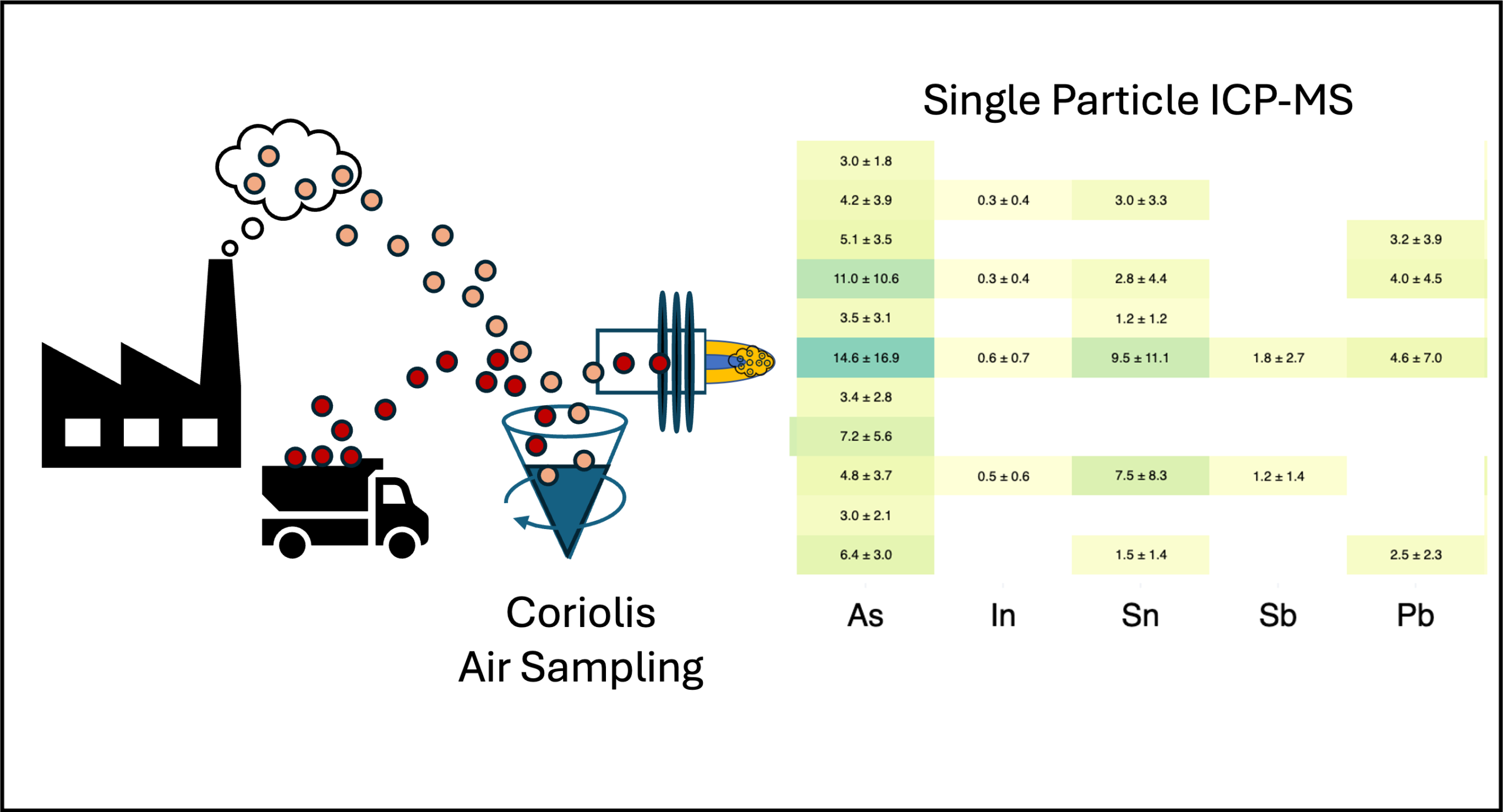
New methods of air sampling and analysis are needed to better understand atmospheric emissions from industrial sources. To close this knowledge gap, 80 air samples were collected around a copper smelter in Quebec using a Coriolis-μ device, allowing for rapid, spatially and temporally resolved samples. Airborne particles were collected directly into water allowing for (a) precise total elemental quantification by inductively coupled plasma mass spectrometry (ICP–MS) following acidification and (b) analysis of individual particle compositions by single particle ICP-Time-of-Flight-MS (spICP-ToF-MS). This new combination of sampling and analytical techniques allowed for better interpretation of the timing, magnitude and elemental signature of emissions from the smelter. Orders-of-magnitude changes in elemental concentrations including As, Pb, and Cd occurred on time scales as short as 15 min, as revealed by high resolution sampling. Furthermore, strong correlations were observed in both bulk elemental concentrations and particle number concentrations (PNCs) among chalcophile elements, including Cu, As, Cd, and Pb. Distance transect sampling further demonstrated the utility of the Coriolis, with 12 sites sampled on a single day. The downwind persistence of airborne metal(loid)s was measured as far as 6 km from the smelter. The coupling of Coriolis sampling with spICP-ToF-MS analysis provided further insights into emission sources of the submicron particles. A consistent proportion of As- and Pb-bearing particles with respect to co-occurring major elements was observed over time, even as PNCs varied by up to 66-fold; this suggested a single source responsible for the majority of the particles. The multielement particle signatures, including In and Sn present with As, Sb, and/or Bi, and a lack of Cu in many of the trace element particles suggested a smelting origin.
Ce contenu a été mis à jour le 30 janvier 2026 à 16 h 04 min.
Commentaires